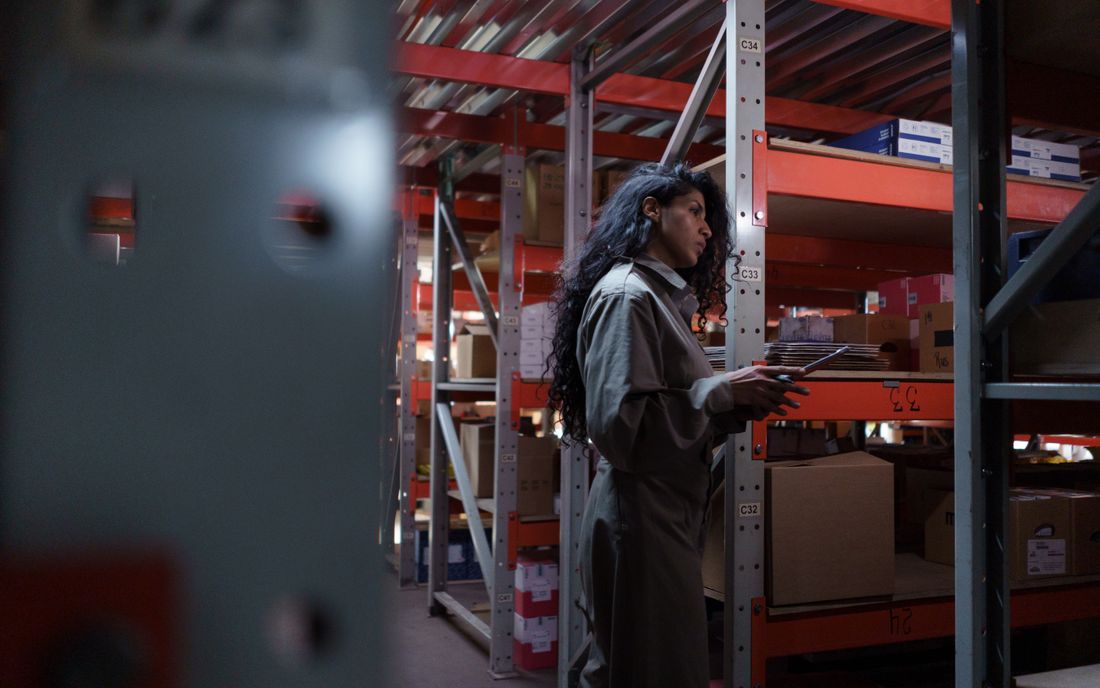
A place for every item: how to organise your shelves
When each item always sits in the same spot, staff find it in seconds, counting is quicker and a loss shows at once. One evening is enough to start.
A customer asks: "Do you have this brand of soap?". The salesperson says "we did" and starts rummaging through the shelves, then runs to the storeroom, then opens a box under the counter for the third time. The customer waits. In the end the item is found, but even then not all of it: some is on the front shelf, some in a box, some in the storeroom, and nobody knows the total. There is one answer to this kind of mess: give every item a fixed place.
Why the place must be fixed
When an item always sits in the same spot, three things get better.
- Speed. Staff find the item in seconds and the customer does not wait.
- Counting. If you count place by place, nothing is counted twice and nothing is skipped.
- Visible shortages. If the usual spot is empty, that is an instant signal: it has run out, gone missing or been put in the wrong place.
An illustrative calculation: if a salesperson looks for items thirty times a day and each search takes two minutes, that is a full hour. With a known place the search takes half a minute, saving forty-five minutes a day. That time goes to selling and talking with customers.
How to mark the places
Divide the shop into simple zones: the counter, the shelves on the shop floor and the storeroom. Then give them codes.
- Number the shelving units: 1, 2, 3 and so on.
- Mark the shelves on each unit with letters from top to bottom: A, B, C.
- This gives you a code: "2-B" means the second shelf of the second unit.
- Write the code at the edge of the shelf on a label or on tape with a marker.
- Add a "Place" column to your item table and write the code next to each item.
Reserve stock should have its own code too. For example, soap on the shelf is "2-B" and the reserve in the storeroom is "Z-4". Then, when stock runs low, it is clear where to fetch more, and the total balance is simply the sum of the two places.
A row in the table might look like this (figures are illustrative): "Soap, 90 g | place: 2-B | on shelf 24 pcs | reserve: Z-4, 60 pcs | total 84 pcs". After a sale or a delivery both figures change, while the total always stays exact.
What goes where
Placement deserves some thought too:
- keep the fastest sellers at eye and hand height, close to the till;
- put heavy and bulky packs at the bottom and light, small items higher up;
- keep small, expensive goods by the till, where the salesperson can see them;
- place similar goods side by side, but separate two different items in almost identical packaging, or they will be mixed up at the sale;
- for goods with an expiry date, put the older batch in front and the newer behind, so that what arrived first sells first.
Rules that keep the order
Order is not a one-off job but a habit. Your team needs only four simple rules:
- An item taken off the shelf goes back to its own place, even if a customer left it on another shelf.
- When new stock arrives, its place is decided first and only then is it put out.
- No "temporary" places. Set aside a separate "to be sorted" corner for stock without a home and empty it once a week.
- Spend ten minutes each week checking that the labels are in place and that nothing has changed shelves.
If these rules hold, even a new employee learns the shop in two days: he looks for a code, not a name.
One evening is enough to begin. After closing, stick numbers and letters on the shelving, take your table and a pen and walk from unit to unit, writing down the code of each item. With two people, the fastest sellers will be done in one evening. In the morning give the sales staff a short briefing, and for the first week let them find goods by code.
Conclusion
An item with a known place is found quickly, counted easily and missed at once if it vanishes. You do not need costly equipment for this: numbers, letters, labels and one extra column are enough. If the goods in your shop are already scattered over three or four places, the AniqHisob team can introduce location storage by unit, row and shelf, run a stock count and transfer the balances into your records tied to the new places.