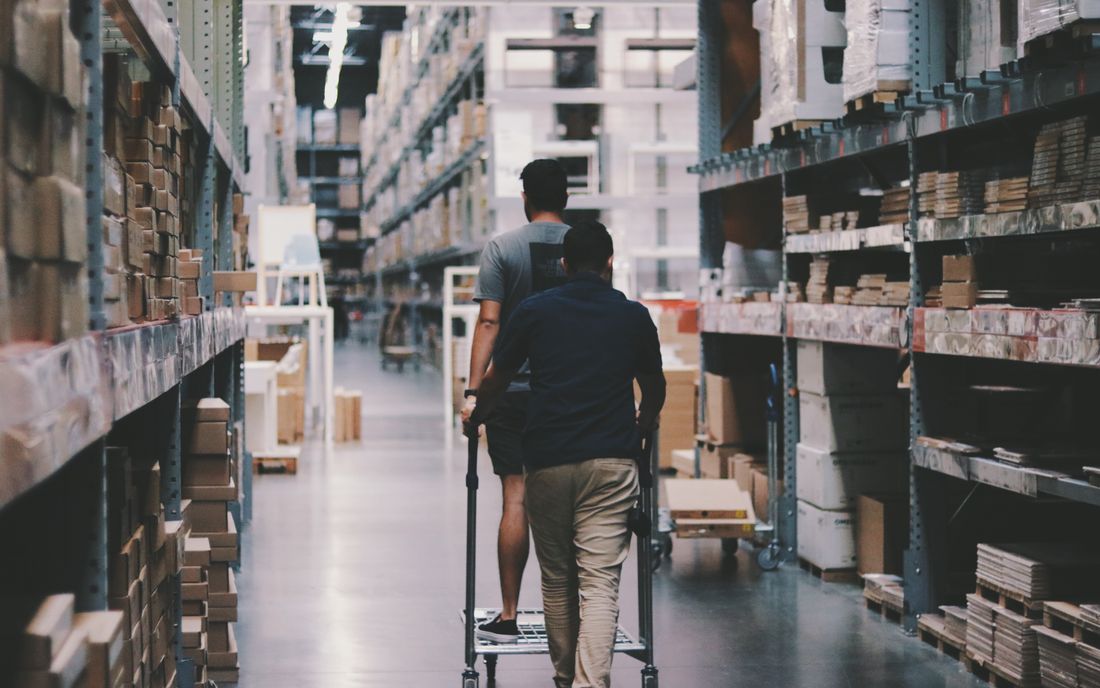
Storing stock at home or in a garage
Even at home stock needs its own place, its own record and labels or it will get 'lost'.
Many people start a business from home: a shop on Telegram, a social-media page, and the goods sit in a bedroom wardrobe or a garage. The thought then arises: "I have no warehouse, so I do not need warehouse records." In fact goods "disappear" fastest at home: they get mixed with family belongings, relatives use them, and the confidence of "I know it well, it is all here" takes the place of records. As an example, take a mother-and-baby shop selling through Telegram: nappies (in sizes S, M, L), baby cosmetics, tableware, about 160 items in all. The stock sits in part of a garage and in a wardrobe at home.
First rule: a separate place and a clear boundary
Set aside one wall, one wardrobe or one room for the goods and mark its boundary with tape or a sign: "Everything in this place is for sale." Explain once to the household: nothing is taken from this shelf without asking, and if something is needed, say so first. Otherwise two packs of nappies "go indoors", you find them neither in the table nor in sales, and a customer is left waiting for that size.
Address and label: find things by system, not by eye
160 items do not stay in memory. Mark the shelves: A1, A2, B1, B2. Stick a label on each shelf or box: item code, size, quantity. Add a "location" column to the table: "nappies M, up to 4 years, B2". This is the simplest form of location storage. The five minutes spent hunting for goods when an order comes in drop to one, and with ten orders a day the time saved is noticeable. Put the sizes of one product (S, M, L) on different shelves and keep them as separate rows in the table too, otherwise you will mix them up. Set aside a separate "dispatch shelf" for order picking: goods that are picked but not yet sent sit there and are marked "reserved" in the table.
The hazards of home conditions
A garage and a house are not a warehouse, so the risks differ:
- damp: do not put goods on the floor, place them on a board or pallet 10 to 15 cm high and keep them away from the wall;
- temperature: goods that freeze in winter and melt in summer heat (liquid cosmetics) should be kept inside the house;
- insects and rodents: replace cardboard boxes with closed plastic containers and keep nappies and clothing covered so rodents cannot spoil them;
- smell and chemicals: keep goods away from fuel, paint and chemicals, and store food separately;
- fire: do not leave goods next to heaters, a gas cylinder or the electrical panel.
Records: issues and the hidden cost
Record receipts promptly too. A courier leaves a parcel at the door and you open it in the evening, tired. The rule is the same: until it is opened and counted, it does not go on the shelf or into the table.
Issues of home-stored goods are not only sales. "I took a pack for myself", "I gave one to my sister": these are issues too, so record them as "own use" or "gift" with a note. Otherwise a shortage appears at month end and nobody remembers the reason.
A home is not free. Suppose that if you rented out this part of the garage you would receive 1,200,000 so'm a month. This is an unpaid but real cost. If the month's profit is 4 million so'm, then after rent it is in effect 2.8 million. Knowing this figure while keeping records helps you judge when the business is ready to leave the house and rent a separate space. The signal is simple: when shelves are full and goods start to spread across the floor, the rooms and the hallway, the house is too small.
Conclusion
Even when stored at home, goods are still goods: they need a separate place, a clear address, recorded issues and a monthly count. This routine keeps serving as the business grows, and moving from the house to a warehouse does not mean rebuilding the table. If you are already muddled about what lies where, the AniqHisob team can run a stock count and help set up location storage.